
The Spanish construction industry moves more than 180 billion euros a year and employs over 1.5 million people, according to data from SEOPAN (Spanish Construction Employers' Association) and the Fundación Laboral de la Construcción (Construction Labor Foundation). Yet the sector remains one of the least digitized in the economy: more than a third of Spanish construction companies still lack digital management tools, according to the report El sector de la construcción y las TIC (The Construction Sector and ICT) from the Observatorio Industrial de la Construcción (Construction Industry Observatory).
The result is predictable: delayed projects, spiraling costs, and teams working with outdated information scattered across Excel files, WhatsApp groups, and paper folders.
Construction management software is the solution. In this guide, you will find everything you need to choose the program that best fits your company: what features are essential and how to compare the best construction management software options for 2026.
What Is Construction Management Software?
Construction management software is a digital platform that centralizes all the information and processes of a project: budgets, purchasing, invoicing, planning, quality control, documentation, and team management.
Unlike generic accounting programs or conventional project management tools, this type of software is designed specifically for the lifecycle of a construction project — from the initial budget estimate through to final certification and project close.
The most complete solutions function as SaaS or ERPs specialized in construction: they integrate all departments and project phases into a single platform, eliminating the need to juggle multiple disconnected tools.
Who Needs Construction Management Software?
This type of tool is designed for:
- Construction firms and contractors managing multiple simultaneous projects who need centralized control.
- Renovation and retrofit companies looking to improve per-project profitability.
- Facilities management companies with field teams who need to track work orders and time.
- Project managers and site managers who need real-time information without relying on manual reports.
Why Excel and WhatsApp Are No Longer Enough
Many construction companies in Spain still manage their projects with spreadsheets, WhatsApp groups, and emails. It is understandable — these are tools everyone knows and they carry no apparent license cost.
The problem emerges as the company grows.
With more than two or three active projects running in parallel, information starts to fragment. A budget modified in Excel does not automatically update purchasing records. A change communicated via WhatsApp is not recorded anywhere. An invoice sent by email takes days to process.
The result: budget variances that nobody catches in time, coordination errors that generate costly rework, and a complete lack of financial visibility across the business.
According to the Observatorio Industrial de la Construcción report, Spanish construction has digitization indicators significantly below the average of other economic sectors. Yet this gap is at once the sector's biggest problem and its greatest opportunity for competitiveness.
Construction companies adopting construction management software in Spain are achieving up to a 30% reduction in time spent on administrative tasks, real-time detection of cost variances, and improved communication between office and site without relying on informal channels.
Essential Features of Construction Management Software in 2026
Not all programs offer the same capabilities. Before comparing options, it is important to be clear about which modules are genuinely necessary for your type of company.
Budgets and Quantity Takeoffs with BC3 Format
The software must allow for detailed budgets broken down by line items, chapters, and project phases. Compatibility with the BC3 (FIEBDC) format is essential in Spain: it is the standard for exchanging budgets between construction firms, architects, and public authorities. Without BC3, it is not possible to participate in public tenders or work with most sector stakeholders.
Learn more: BC3 Format
Real-Time Cost Control and Certifications
Comparing budgeted cost against actual cost in real time is the most critical function for profitability. Good construction management software enables this tracking automatically, by line item, by project, and by company. Without this feature, variances are discovered only when there is no room left to correct them.
Purchasing Management Linked to the Budget
Control of purchase orders, delivery notes, and supplier invoices linked directly to the project budget. Without this module, it is impossible to know whether purchases are within the planned margin.
Planning with Gantt Charts
Visual planning of tasks and project phases, with resource assignment and dependency detection, is essential for coordinating teams and catching delays before they happen.
Centralized Document Management
Drawings, permits, contracts, inspection records, quality tests, and all project documentation in a single digital repository, accessible from any device with full traceability.
Quality Control, Inspections, and Punch Lists
Inspection forms, punch lists, defect records, and quality tests completed directly from a mobile phone or tablet on site.
Geolocated Time Tracking
Especially relevant since the entry into force of Spanish mandatory working-hours recording legislation, the software must enable geolocated time tracking for the team and generation of digital work reports.
Invoicing Compatible with Verifactu
Invoicing integrated with the project module, with support for the Verifactu system mandatory in Spain under Royal Decree 1007/2023 (Real Decreto 1007/2023). Software without Verifactu forces you to manage invoicing in a separate tool, breaking project traceability.
Mobile Access from Site
The ability to view and update information directly from the job site is now a basic requirement, not a differentiator. If the site manager cannot use the tool from their phone, field data will never be up to date.
The 10 Best Construction Management Software Options in Spain (2025)
Below is an honest comparison of the most widely used solutions in the Spanish market, with their strengths, limitations, and the company profile each suits best.
1. Trowel: Recommended for Spanish Construction Firms
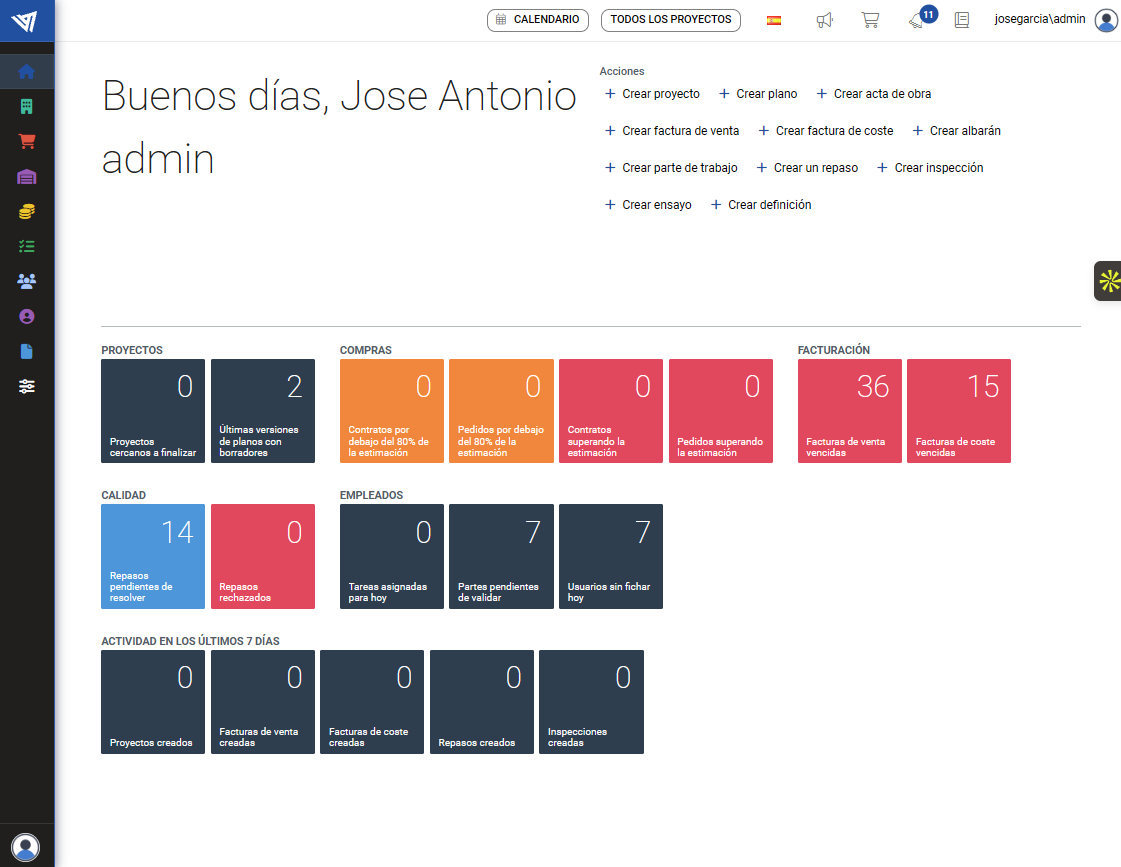
Profile: Construction companies, architecture practices (site supervision), renovation and facilities management SMEs in Spain. Trowel is the construction management software designed specifically for construction firms and project companies in Spain. Unlike other solutions, it combines site management, quality control, and native Spanish regulatory compliance (Verifactu, BC3) in a single cloud platform, with no external integrations required.
Its modules include budgets with BC3 import, purchasing management linked to the budget, Verifactu invoicing, Gantt planning, site minutes, inspections, punch lists, quality tests, geolocated time tracking, and work reports — all accessible from any device, including a native app for iOS and Android.
Strengths:
- Native Spanish regulatory compliance: BC3, Verifactu, working-hours recording
- Intuitive interface with a very short learning curve — teams are operational in under a week
- Spanish-language support with personalized attention
- Integration with Holded for accounting
- More than 5,000 active professionals in Spain
Ideal for: Construction companies with 5 to 150 employees, architecture practices (site supervision), renovation and retrofit companies, facilities management companies with field teams.
👉 Request a free TrowelApp demo
2. BrickControl
Profile: Mid-sized construction firms requiring budget control and subcontractor management.
Spanish cloud software with a subcontractor management module and site monitoring. Offers planning, mobility, and accounting integration features.
Strengths: Subcontractor management, mobile app, accounting integration.
Limitations: Steeper learning curve than some alternatives.
3. Presto (RIB Software)
Profile: Architecture firms, quantity surveyors, and technical site managers focused on advanced estimating.
Presto is the reference program in Spain for budget preparation and quantity takeoffs. It has been on the market for decades and has the largest user base among design professionals.
Strengths: Powerful technical estimating, comprehensive price database, BC3 compatible.
Limitations: Desktop software (on-premise), no comprehensive site management features for execution, no functional mobile app for field use, non-intuitive interface.
4. ConstruCloud
Profile: Construction firms needing budget control with advanced financial reporting.
Cloud solution with a strong document management module and financial reporting. Oriented toward companies that need financial visibility over their projects.
Strengths: Advanced financial reports, document management.
Limitations: Less depth in quality control and field management.
5. Gestproject
Profile: Site managers and quality control teams during the execution phase.
Software specialized in document management and construction project planning, widely used in site supervision.
Strengths: Powerful document management, planning, traceability, defect tracking.
Limitations: Does not comprehensively cover financial management and purchasing.
6. SIS Grupo
Profile: Large construction groups requiring a complete multi-sector ERP.
General-purpose ERP with a construction-adapted module. Offers accounting, HR, CRM, and warehouse management integration.
Strengths: Full integration with accounting and HR, scalability for large groups.
Limitations: Complex implementation, high cost, not specifically designed for construction.
7. AecoSoft
Profile: Mid-sized construction firms requiring financial control and subcontractor management.
Construction-specialized ERP with a strong financial control module. Cloud solution with support in Spain.
Strengths: Financial control, subcontractor management, local support.
Limitations: Smaller presence and user community than other options.
8. Sage Construcción
Profile: Companies already using Sage for accounting that want to extend it to project management.
Sage's solution adapted for the construction sector, with native integration across the Sage accounting ecosystem.
Strengths: Seamless accounting integration for Sage users, recognized brand support.
Limitations: Not a native construction solution — site management features are less deep than those of specialized software.
9. Project Manager Pro
Profile: Project teams that prioritize planning and resource control.
General-purpose project management tool with strong planning capabilities and Gantt charts, not specialized in construction.
Strengths: Advanced planning, team collaboration, modern interface.
Limitations: No construction estimating, no construction-specific cost control, no BC3 or Verifactu.
10. Microsoft Dynamics 365
Profile: Large construction groups requiring a global ERP integrated with the Microsoft ecosystem.
Microsoft's global ERP with a construction-adapted module, with maximum integration with Office 365 and Teams.
Strengths: Full Microsoft integration, global scalability, powerful analytics.
Limitations: Very high implementation cost, requires specialized consultancy, not designed for mid-sized construction firms.
|
Software |
Type |
Deployment |
BC3 |
Verifactu |
Mobile App |
Ideal Profile |
|
Trowel |
Full site management |
Cloud |
✅ |
✅ |
✅ |
Construction SMEs (Spain) |
|
BrickControl |
Site management |
Cloud |
✅ |
|
✅ |
Mid-sized |
|
Presto |
Estimating |
On Premise |
✅ |
|
|
Technicians/studios |
|
ConstruCloud |
Financial management |
Cloud |
✅ |
✅ |
✅ |
Mid-sized |
|
Gestproject |
Documentation/ planning |
Cloud |
|
|
✅ |
Site supervision |
|
SIS Grupo |
Multi-sector ERP |
On Premise |
✅ |
✅ |
Partial |
Large groups |
|
AecoSoft |
Construction ERP |
Cloud |
✅ |
✅ |
✅ |
Mid-sized |
|
Sage Construcción |
General ERP |
Cloud |
✅ |
✅ |
✅ |
Sage users |
|
Project Manager Pro |
Project management |
Cloud |
|
|
✅ |
Project teams |
|
MS Dynamics 365 |
Global ERP |
Cloud |
✅ |
✅ |
✅ |
Large groups |
How to Tell Whether Construction Software Is Truly Reliable
Choosing reliable software goes beyond reading the features listed in the sales brochure. These are the real indicators you should evaluate:
Time in the market and active client base. Software that has been deployed for years and has thousands of active users has survived the problems that inevitably surface in real-world use. Ask for references from companies similar to yours in Spain.
Local Spanish-language support. When an issue arises on site, you need a fast response from someone who understands Spanish regulations and knows how a construction company actually works day to day.
Frequent updates with regulatory adaptation. Software that does not update is software that does not improve. Check the version history and whether updates include adaptations to recent Spanish regulations such as Verifactu or mandatory working-hours recording.
Real ease of adoption. The best indicator is not the demo with the sales rep — it is how long it takes a site manager who has never used management software to get up to speed. Request a trial period with your actual team and your actual data.
Security and GDPR compliance. Your budgets, costs, and client data are critical assets. Verify that the provider complies with the General Data Protection Regulation (GDPR) and that data is stored on European servers.
Trowel meets all of these criteria: more than 5,000 active users in Spain, personalized support during Spanish business hours, regular updates aligned with Spanish regulations, onboarding in under a week, and data storage within the European Union.
How to Choose the Right Construction Management Software for Your Company
There is no perfect software for every construction firm. The right choice depends on several factors you should analyze before making a decision.
1. Define Your Company Profile
How many projects do you manage simultaneously? How large is your workforce? Is your core activity residential construction, civil engineering, renovation, or maintenance? A construction firm with 5 active projects and 20 employees has very different needs from a large group with 200 projects. Make sure the software you choose is built for your scale.
2. Identify the Modules You Actually Need
Do not pay for features you will not use. List the processes you want to digitize — estimating, purchasing, planning, quality control, time tracking — and check which solutions cover them without forcing you to purchase additional modules.
3. Verify Spanish Regulatory Compliance
If your company operates in Spain, the software must comply with local regulations: Verifactu compatibility for electronic invoicing, support for mandatory working-hours recording, and the ability to manage health and safety (PRL) documentation. Without these requirements, you will still be handling those processes outside the system.
4. Evaluate Ease of Adoption
The best software is the one your team actually uses. A very powerful tool with a steep learning curve can end up being abandoned. Ask about the average onboarding time and request to speak with current clients of the provider.
5. Check the Quality of Local Support
For a company in Spain, Spanish-language support with knowledge of the local sector is not a luxury — it is a necessity. When a problem arises on site, you need a fast response from someone who understands your context.
6. Request a Demo with Your Own Data
No software should be purchased without first being tested in your real-world context. Ask for a demo using an actual budget and an active project — not sample data — and evaluate how the system performs in your day-to-day operations.
How Much Does Construction Management Software Cost in Spain?
Prices vary considerably depending on the type of solution, number of users, and contracted modules.
As a general guide, in the Spanish market you can expect:
Cloud solutions for SMEs (5–50 users): between €100 and €500 per month, depending on modules and the number of active projects.
Full ERPs for mid-sized companies: between €500 and €2,000 per month, plus additional implementation costs.
Global ERPs (Dynamics 365, SAP): projects that can exceed €50,000 in implementation costs plus annual licensing.
The most important thing is not the license price, but the return on investment. A construction firm that catches a 5% cost variance in time on a €500,000 project saves €25,000. The software pays for itself.
Trowel offers plans adapted to the size of each company, with access to all modules from day one. See pricing here.
Common Mistakes When Digitalizing a Construction Company
Choosing the cheapest software without analyzing the total cost. The license price is only part of the cost. Training, data migration, implementation time, and support all have a real impact on the budget.
Not involving the site team from the start. If the site manager and supervisors are not part of the tool selection process, adoption will be very difficult. The software must solve their real problems, not just those of management.
Trying to digitize everything at once. Gradual digitization works better. Start with the module that delivers the most immediate value — typically estimating or cost control — and add modules progressively.
Not migrating historical data. Starting from scratch without data from previous projects makes it impossible to compare profitability and learn from past work.
Choosing software not adapted to the Spanish market. Tools designed for English-speaking or Latin American markets typically do not cover Spain-specific regulatory requirements: Verifactu, BC3, PRL, working-hours recording.
Frequently Asked Questions About Construction Management Software
What construction management software is best for a Spanish SME?
For mid-sized construction and renovation companies in Spain, Trowel is one of the most complete options on the market. It covers all necessary modules — estimating, purchasing, invoicing, planning, quality control, and time tracking — in a cloud platform with Spanish-language support and native regulatory compliance (Verifactu, BC3, PRL).
What is the difference between a SaaS/ERP construction platform and estimating software like Presto?
Presto is a tool specialized in estimating and quantity takeoffs. It is very powerful for that specific function, but does not cover comprehensive site management. A construction management platform, by contrast, integrates estimating, purchasing, invoicing, planning, quality control, and document management in a single platform, eliminating the need to pass information manually between systems.
What software do you recommend for managing a construction company?
It depends on the size and type of activity. For Spanish construction firms with 5 to 150 employees, Trowel offers the best balance between functionality, ease of adoption, and price. For large groups requiring complex accounting integration and HR management, an ERP like SIS Grupo or Dynamics 365 may be more appropriate. For complex technical estimating, Presto remains the benchmark.
What is the best software for managing a mid-sized construction firm in Spain?
For mid-sized construction firms in Spain (between 20 and 100 employees, with several active projects running simultaneously), Trowel offers the best functionality/price/adoption ratio. It covers the complete project lifecycle without requiring external integrations, and its onboarding does not require specialized consultancy.
Is it mandatory for software to be compatible with Verifactu?
For companies that issue invoices in Spain, Verifactu compatibility is mandatory under Royal Decree 1007/2023. Although the definitive entry into force has been delayed, choosing software that is already compatible is essential to avoid having to migrate systems at a later stage.
What is BC3 format and why does it matter in construction software?
BC3 (FIEBDC-3) is the standard for exchanging construction budgets in Spain. It allows budgets to be imported and exported between different programs without loss of information. It is particularly relevant for public tenders, where many contracting authorities require budgets in this format. Construction management software in Spain must be BC3 compatible.
Is a cloud solution better than an on-premise installation for construction?
In most cases, yes. Cloud solutions allow access to information from anywhere, including directly from the job site, without needing to be in the office. Updates are applied automatically and do not require in-house IT infrastructure. For companies with multiple projects or distributed teams, the cloud solution is clearly superior.
How can you verify that construction software is reliable before signing a contract?
Always request a demo with your own data — a real budget and an active project. Speak with current clients of the provider who run companies similar to yours. Review the update history and check that support is available in Spanish during Spanish business hours. A good provider will have no problem offering you a trial period before any contract is signed.
Related Content
- Construction software: benefits of digitalizing from the start of the project
- How construction management software improves project profitability
- From Excel to full control: how to digitalize your site management step by step
- Digital tools for construction management in Spain
- Construction management app: complete guide for Spain
- Construction software: the new standard in professional management
- Online construction budget tools in Spain
- Software for construction site control
Conclusion
Construction management software is no longer an optional investment for Spanish construction firms — it is a competitive necessity.
The Spanish construction sector is growing; public tendering grew 11.6% through November 2025, according to SEOPAN data. But expectations are also rising: for document traceability, cost control, regulatory compliance, and the ability to work with real-time information.
Construction firms still managing their projects with Excel and WhatsApp are leaving money on the table with every project: variances that are not caught in time, purchases that exceed the budget, unbilled labor hours, and invoices that arrive late.
Digitization is not complicated. It is a matter of choosing the right tool for your size and starting with the module that has the greatest immediate impact on your business.
Want to See Trowel in Action with Your Own Projects?
Book a free demo and we will show you, using real data from your company, how Trowel can improve the management of your projects from day one.