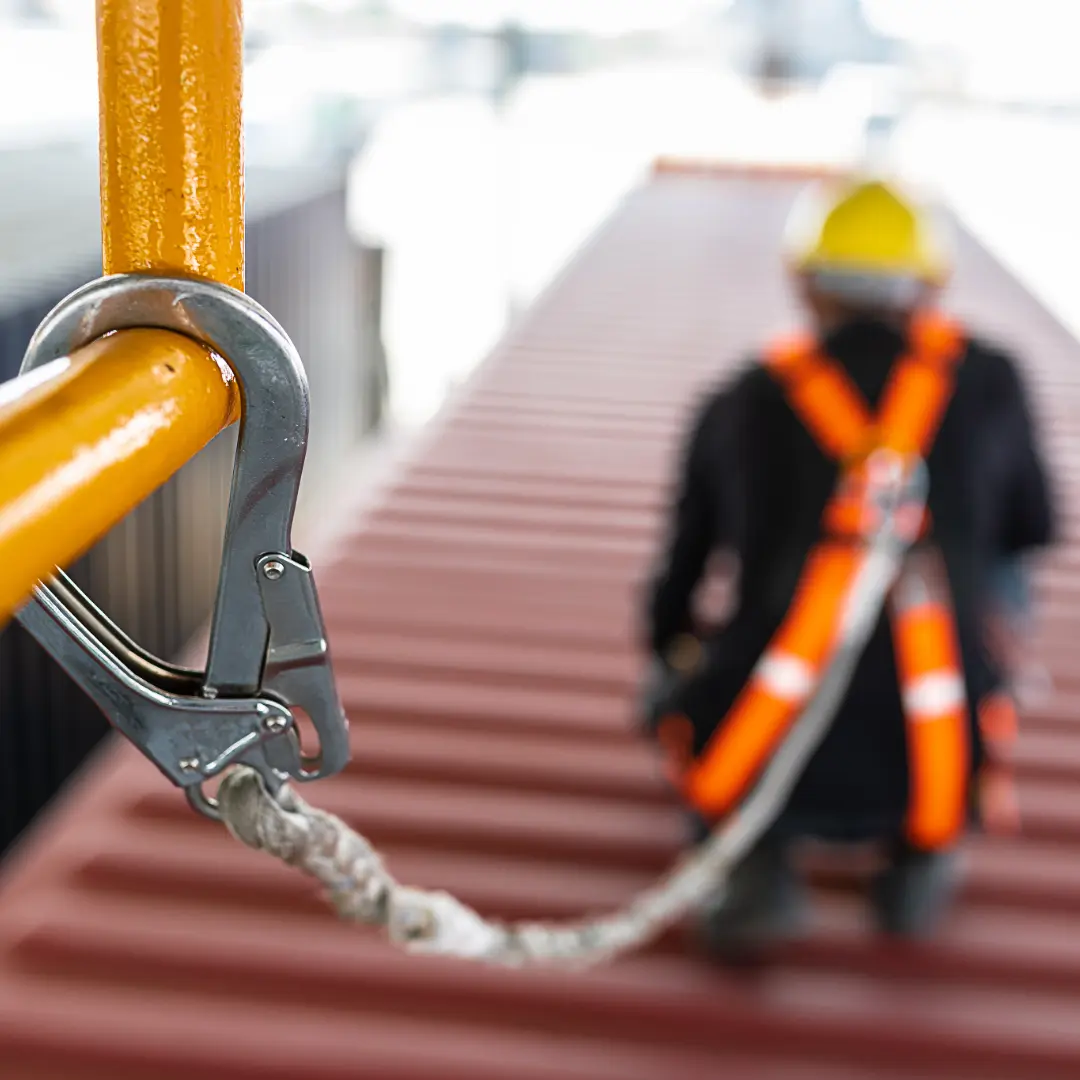
Health and safety measures on a construction site in México are essential to protect workers and guarantee legal compliance, within the wider framework of construction safety. Every site has its own specific risks: fire, falls, exposure to chemicals, heavy machinery, electricity and work at height. Applying these measures not only reduces accidents arising from unsafe acts and unsafe conditions, it also builds a culture of prevention and efficiency.
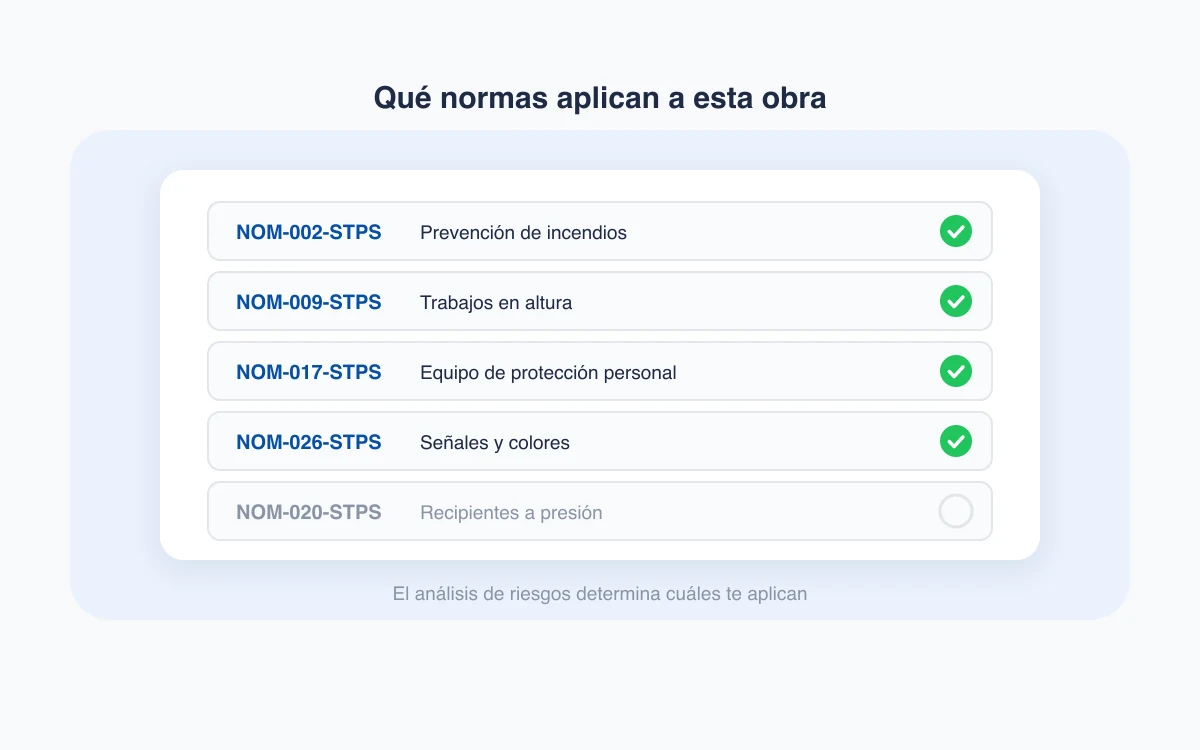
Unlike NOM-031-STPS-2011, which sets the general framework of safety conditions for any construction project, the standards set out below govern specific risks, fire, machinery, chemicals, electricity, that may or may not be present depending on the type of project. Identifying which ones apply to your particular site is the first step before implementing them.
In this guide we review, standard by standard, what the STPS requires for each type of risk present on a site, including the hygiene standards (noise, chemical agents and lighting) that tend to be forgotten. If what you are after is the overall picture and how to organize a site safety program step by step, you will find it in our guide to construction safety.
Fire prevention and protection
(NOM-002-STPS-2010) Fire is a serious risk on any site. Installing extinguishers in visible places, signposting evacuation routes and training personnel in emergency plans are essential actions. Regular drills are recommended to improve the response to incidents.
Machinery and equipment safety
(NOM-004-STPS-1999) Machinery is one of the main occupational risks. Guards and emergency stop systems must be fitted, and regular inspections scheduled. Training operators and marking out hazard zones makes the environment safer for everyone.
Handling and storage of materials
(NOM-006-STPS-2023) Handling materials incorrectly can cause serious injury. NOM-006-STPS-2023 has been in force since 3 September 2024, replacing the 2014 version, and focuses on storing and handling materials with machinery such as forklifts, cranes or hoists: it requires an inspection and maintenance program for that machinery, operating procedures and records. Manual handling of loads, such as carrying bags of cement, block or rebar, is governed by NOM-036-1-STPS-2018, which requires ergonomic risk factors to be analyzed and limits on lifted loads to be respected. Classifying and storing materials correctly and avoiding dangerous stockpiles complete these measures.
Work at height
(NOM-009-STPS-2011) Falls are one of the main causes of serious accidents. Using harnesses, lifelines, guardrails and safety nets, alongside constant supervision and training personnel in rescue, is crucial for safety at height. You can see the full treatment in work at height: preventing falls on site.
Personal Protective Equipment (PPE)
(NOM-017-STPS-2024) PPE is the last barrier of protection against occupational risks. NOM-017-STPS-2024 has applied since 28 September 2025, replacing the 2008 version. Selecting the right hard hat, gloves, boots, eye protection, vest and hearing protection, providing the equipment at no cost, and running an inspection and replacement program are recommended practices. Find out more in Personal Protective Equipment under NOM-017-STPS-2024.
Hazardous chemical substances
(NOM-018-STPS-2015) Exposure to chemicals can cause poisoning and burns. NOM-018-STPS-2015 establishes the harmonized system for identifying and communicating the hazards of chemical substances: labelling containers correctly, keeping safety data sheets accessible on site, and training personnel in safe handling and spill response. On site it applies to products such as admixtures, form release agents, solvents, paints and waterproofing products.
Pressure vessels and boilers
(NOM-020-STPS-2011) Poor maintenance of boilers or pressure vessels can cause explosions. Regular inspections, staff training and maintenance records are necessary measures to prevent serious accidents. In building work there are rarely boilers, but there are usually air compressors with a tank, which are pressure vessels.
Safety signs and colors
(NOM-026-STPS-2008) Correct signage reduces accidents by communicating risks, evacuation routes and restricted areas visually and immediately. Using the colors and symbols the standard sets out, and keeping them visible and in good condition, avoids confusion that can prove costly in an emergency.
Maintenance of electrical installations
(NOM-029-STPS-2011) Electrical faults can be fatal. Regular inspections, lockout and tagout of equipment and training personnel in electrical safety are essential to minimize risk.
Preventive health and safety services
(NOM-030-STPS-2009) Preventive services make it possible to anticipate risks and maintain a safe environment. Setting up safety teams, carrying out regular inspections and encouraging active participation by personnel all strengthen the culture of prevention.
Noise
(NOM-011-STPS-2001) Cut-off saws, rotary hammers, mixers, compactors and heavy machinery expose personnel to noise levels that, over time, cause irreversible hearing damage. The standard requires the noise of areas and equipment to be identified and assessed, control measures to be applied, hearing protection appropriate to the exposure level to be provided, and the hearing health of exposed personnel to be monitored.
Airborne chemical contaminants in the workplace
(NOM-010-STPS-2014) Beyond handling substances safely, you have to control what people breathe. On site, the typical cases are the dust generated when cutting or demolishing concrete, block and stone, and the vapors from solvents, paints and waterproofing products in poorly ventilated spaces. The standard requires those agents to be identified, personnel exposure to be assessed against their limit values, and control measures to be applied, such as wet cutting, local extraction, ventilation or respiratory protection.
Lighting
(NOM-025-STPS-2008) Basements, stair shafts, interiors without their final electrical installation and night work are areas where poor lighting causes trips, falls and mistakes. The standard sets minimum lighting levels according to the visual task and the work area, so it is worth planning the site's temporary lighting from the outset rather than solving it with loose lamps.
Temporary welfare facilities
Beyond the NOM standards by type of risk, hygiene on site includes basic facilities for personnel: sufficient and clean sanitary facilities, drinking water, a suitable place to eat and a first aid kit. Check what NOM-031-STPS-2011 and your local building regulations require on this point, and size these facilities according to the number of workers in each phase of the project.
Common mistakes when implementing health and safety on site
Applying the measures only in the areas visible during an inspection. Complying with the standard only where it is easy to verify, and neglecting the rest of the site, leaves exposed exactly the areas where most accidents happen.
Buying PPE and safety equipment once, with no replacement plan. Cracked hard hats, worn harnesses or expired extinguishers stop serving their purpose even though they are still present on site.
Treating each standard as an isolated requirement rather than a connected system. Signage, PPE, training and the maintenance of installations reinforce one another; implementing them separately, with no connection, leaves gaps that no individual measure covers.
Training on paper without checking that people apply what they learned in the field. A signed training certificate does not guarantee that the worker uses PPE correctly or follows the work at height procedure once the shift starts; supervision on site is what confirms whether the training really translated into safe behavior.
Frequently asked questions
Which health and safety standards apply on almost every site?
The basis is NOM-031-STPS-2011, specific to construction. On top of that, practically every site has to comply with NOM-017-STPS-2024 (PPE), NOM-026-STPS-2008 (signage), NOM-002-STPS-2010 (fire prevention) and NOM-019-STPS-2011 (health and safety commission), and almost all of them with NOM-009-STPS-2011, because at some point work takes place above 1.80 m. The rest depend on the specific risks of each project.
Is it mandatory to implement all these measures on a site of any size?
Whether they are mandatory depends on the risks present on each specific site, not only on its size: a small project involving work at height or the handling of chemical substances has to comply with those standards just as a large one does.
What happens if the STPS finds non-compliance during an inspection?
It can lead to fines of 250 to 5,000 times the UMA, under article 994, section V, of the Federal Labor Law, plus the risk of activities being suspended in the most serious cases until the conditions observed are corrected.
How do I know which of these standards apply to my specific site?
It depends on the activities and risks present: a site with no heavy machinery does not need the same deployment of NOM-004 as one with cranes and mixers, but practically no site is exempt from PPE, signage and fire prevention. The initial risk analysis required by NOM-031-STPS is what determines which specific standards apply in each case.
Conclusion
Health and safety measures on a construction site in México are essential to protect lives, prevent accidents and comply with the regulation of the Secretaría del Trabajo y Previsión Social. From fire prevention and work at height to handling chemicals, PPE and electrical maintenance, each standard contributes to creating a safe working environment. Book a Trowel demo and digitize safety inspections across your sites.