
In construction, problems such as delays or cost overruns do not arise from a single cause, but from a chain of interrelated failures. Yet they are often addressed superficially, without identifying their real origin. The problem tree allows these situations to be analyzed in a structured way, identifying root causes and transforming them into concrete solutions. In this article you will see how to apply it with real examples from the job site, step by step, to improve planning and prevent project delays.
What is a problem tree?
The problem tree is a causal analysis methodology that allows the causes, central problem, and effects of a negative situation to be visualized in a structured way. Its name comes from the analogy with a tree:
- The roots represent the deep causes of the problem.
- The trunk is the central problem we want to solve.
- The branches and leaves are the effects that problem generates.
This methodology is the foundation of any solid solutions tree and is especially useful in construction, where problems are multifactorial and decisions carry a high economic impact.In Spain, nearly 70% of building projects suffer delays. The problem tree allows you to identify exactly where planning breaks down and how to fix it.
Steps to create a problem tree
Step 1 — Define the central problem
The starting point is to state the problem in a neutral, concrete, and measurable way. Avoid including causes or effects at this stage.
Real example: "Systematic project delays due to failures in planning and monitoring"
Trowel tip: Validate the statement with the site manager, supervisors, and subcontractors before continuing. If there is no consensus on the problem, the entire tree will lose coherence.
Step 2 — Identify the effects (the branches)
Effects are the visible consequences of the problem: the branches growing upward in the tree. Ask: what does this problem cause on site? Following the example, delays drive cost overruns from overtime and contractual penalties, friction with the client and the site management team, poor coordination between subcontractors, and lost project margin. State each effect concretely: the clearer they are, the easier it will be to measure the improvement once you solve the problem.
Step 3 — Identify direct causes
Ask: What is directly causing the delays? In this case: an unrealistic schedule with no buffer time, failures in the materials supply chain, and project changes handled with no formal protocol.
Step 4 — Dig into the root causes
Apply the 5 Whys technique to each direct cause. This leads you to the real origins: absence of a Lean methodology (only a static Gantt), suppliers with no traceability, and the absence of a formal change control process.
Step 5 — Transform the tree into solutions
Invert each negative element: the central problem becomes the objective, the root causes become intervention means, and the negative effects become expected benefits. The result is an action plan connected directly to the real roots of the problem.
Quality criterion: a good tree reads from the bottom up as a logical chain: "Because X, therefore Y, which causes Z."
Practical example: project delays due to poor planning
This is one of the most frequent and costly problems in the sector in Spain. Its effects cascade: a one-week delay in the foundations can translate into three weeks of total deviation by the end of the project, because each trade depends on the one before it.
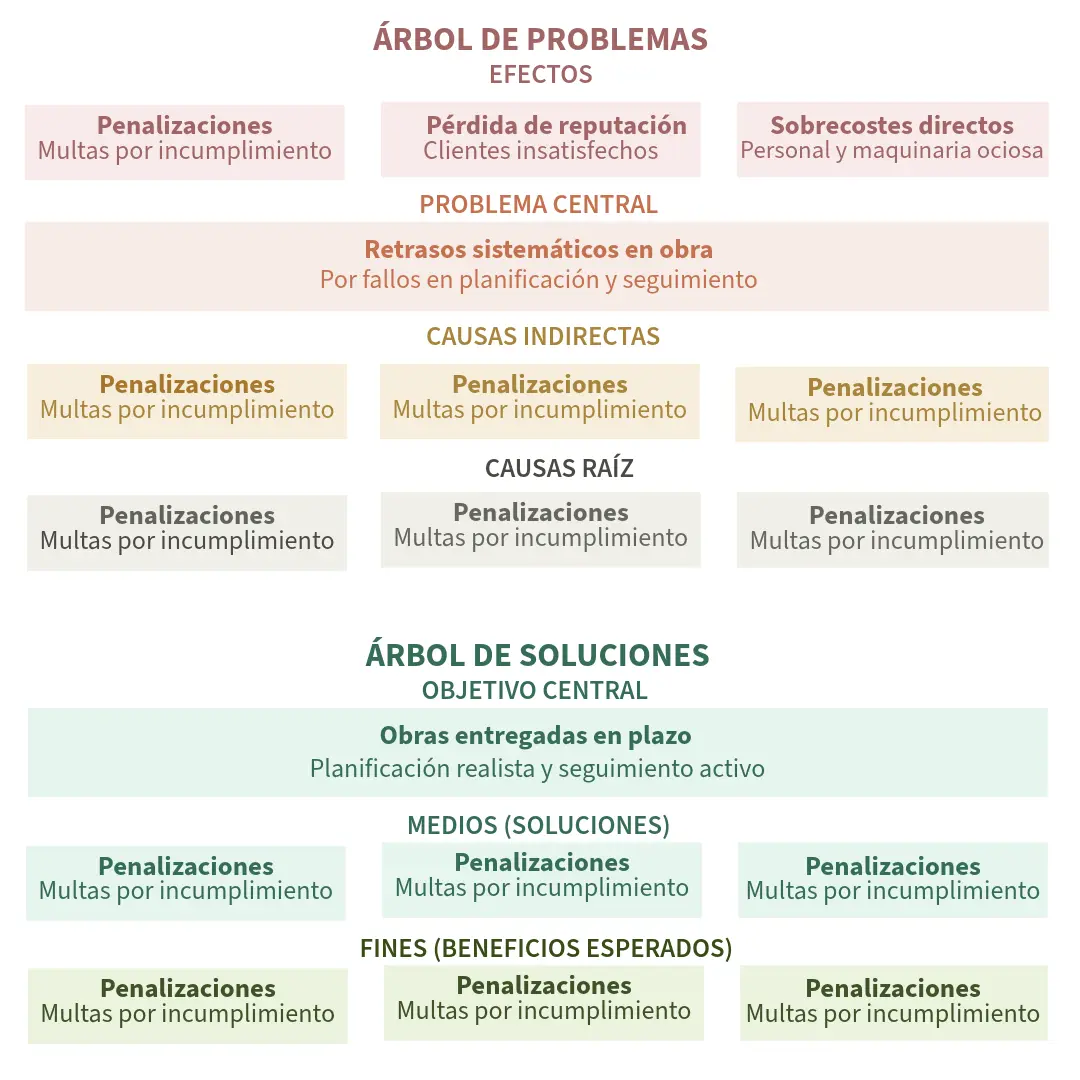
Analysis of the example: what the tree reveals
Unrealistic schedule → Last Planner System The schedule is built backwards from the client's promised delivery date, without validating whether the timelines are technically achievable. The result is a Gantt chart that is already a fiction on day one of the project. The solution is the Last Planner System: the team builds the schedule week by week collaboratively, identifying constraints before they block work. It is the most effective methodology for reducing delays in the Spanish context.
Supply failures → Supplier traceability Orders for critical materials (steel structure, joinery, MEP installations) are placed late because no one monitors the supplier's manufacturing lead times. When the material arrives, work has already been on hold for days. The solution involves digitalizing purchase order tracking with automatic alerts linked to the project schedule.
Project changes → Formal change control Client or project management modifications are handled verbally or by email, without assessing their real impact on the schedule. Each "minor" change that "shouldn't affect anything" adds days without anyone keeping track. A formal change control protocol with mandatory impact assessment and documented approval resolves this issue.
The key transformation: from problem to solution
The solutions tree is built by inverting each negative element of the problem tree:
|
Problem tree |
Solutions tree |
|
Systematic project delays |
Projects delivered on schedule |
|
Unrealistic schedule (root cause) |
Last Planner System (means) |
|
No traceability (root cause) |
Supply chain control (means) |
|
No change control (root cause) |
Formal protocol (means) |
|
Penalties (negative effect) |
Zero penalties (positive outcome) |
|
Reputational damage (effect) |
Solid reputation (positive outcome) |
Most common mistakes when applying this method
- Mixing causes with effects Symptoms are not root causes. "The project is running late" is an effect, not the central problem. The problem is the planning that caused that delay.
- Stating the problem as the absence of a solution "Lack of planning software" is not a problem: it is an implied solution. The real problem is the inability to anticipate constraints before they block work.
- Overly generic tree "Management problems" is not a useful central problem. The more specific the problem, the more actionable the resulting solutions tree.
- Building it alone If only the project manager creates it, the tree reflects a single perspective. The participation of supervisors, subcontractors, and suppliers ensures that the diagnosis is grounded in reality and the solutions are actually applicable.
Conclusion
The problem tree is not a document that gets filed away: it is the starting point for a real action plan. In the case of project delays, applying it allows you to move from "we always deliver late" to a concrete diagnosis with three identified root causes and three precise measures to resolve them.
In Spain, where construction faces real challenges around schedule compliance and increasingly tight margins, mastering this tool makes the difference between a company that reacts to problems and one that anticipates them.